
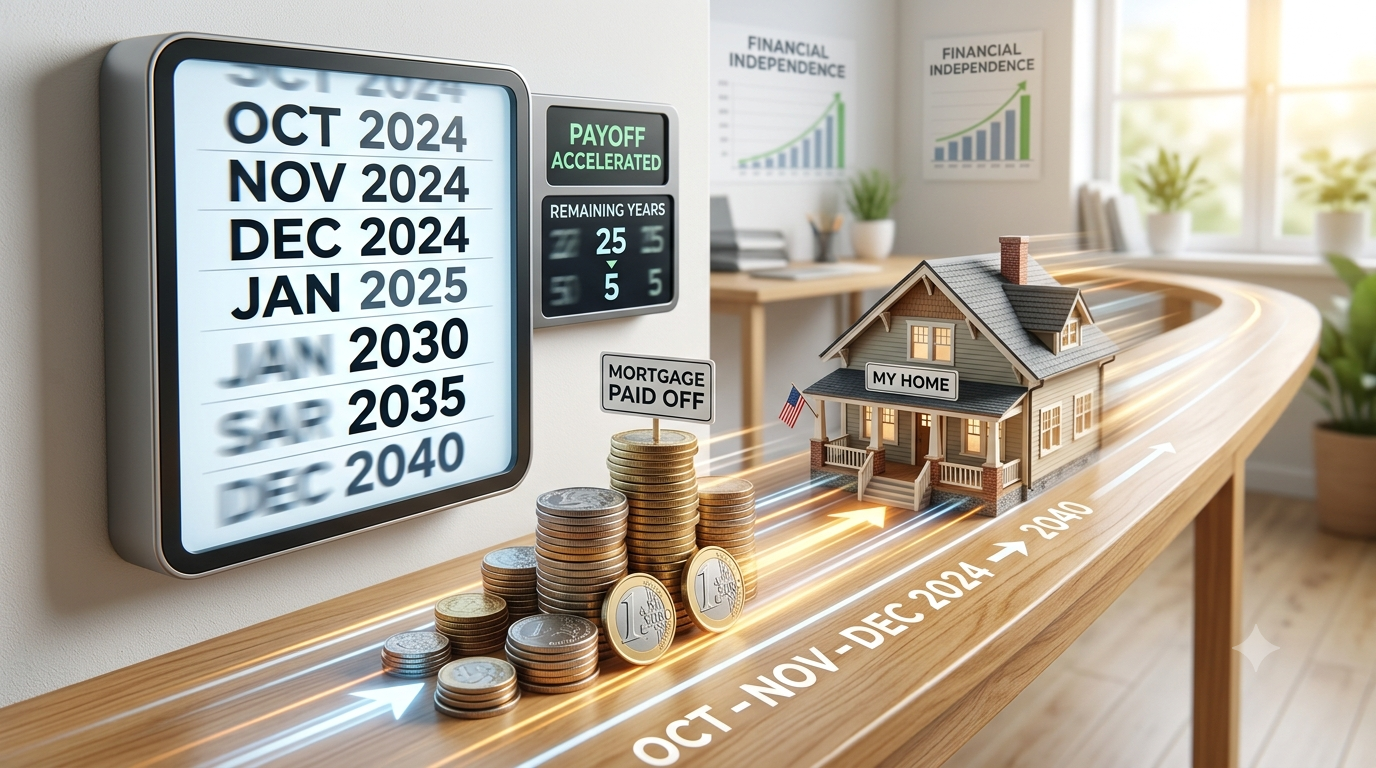

Every EMI you pay is split into two parts: interest owed for that period, and principal — the actual amount reducing what you owe. Early in a loan, most of your payment goes toward interest. Add even a small amount extra toward principal, and you skip ahead in the schedule, cutting both the loan term and the total interest paid. The tricky part is that the impact isn’t linear — a small extra payment early in the loan is worth far more than the same amount paid later. This guide shows exactly why, with worked numbers you can replicate for your own loan.
Why Extra Principal Payments Work So Well
A standard loan uses amortization, meaning your fixed monthly payment covers a shrinking amount of interest and a growing amount of principal over time. When you pay extra toward principal:
- Your outstanding balance drops immediately by that extra amount
- All future interest is calculated on that lower balance
- Every subsequent payment automatically shifts more toward principal
- The loan reaches zero balance sooner — shortening the payoff date
This compounding effect is why even modest extra payments can shave years off a mortgage or auto loan.
Example 1: Extra Monthly Payment on a Home Loan
Suppose you have a $300,000 loan at 7% annual interest for 30 years. Your standard monthly EMI is roughly $1,996.
Now add just $200 extra every month toward principal:
- Standard payoff: 30 years, total interest paid ≈ $418,500
- With $200/month extra: payoff shrinks to roughly 25 years, total interest ≈ $338,000
That’s about 5 years shaved off and roughly $80,000 saved in interest — from an extra payment that’s less than 10% of the monthly EMI.
You can test this yourself with different extra-payment amounts using our EMI Calculator — enter the loan details, then compare the schedule with and without an added monthly amount to see your own numbers.
Example 2: One Annual Lump-Sum Payment
Not everyone can commit to a higher payment every month, but an annual lump sum — a bonus, tax refund, or year-end savings — can have a similar effect.
Using the same $300,000 loan at 7% for 30 years, adding one extra $2,400 payment every year (equivalent to the $200/month example, but paid once annually):
- Payoff shrinks to approximately 26 years
- Total interest saved: roughly $65,000
The savings are slightly lower than the monthly version because the extra amount sits in the loan for less total time across the year, but it’s still a meaningful reduction for a single annual payment.
Example 3: A One-Time Extra Payment Early in the Loan
Timing matters more than most borrowers realize. A single $10,000 extra payment made in year 2 of a 30-year, $300,000 loan at 7% can:
- Cut close to 2 years off the loan term
- Save approximately $28,000–$30,000 in interest
Make that same $10,000 extra payment in year 20 instead, and the effect is far smaller — often less than half the interest saved and only a few months shaved off the term, simply because most of the interest has already been paid by that point in the amortization schedule.
This is the single most important takeaway: extra payments made early in a loan are worth significantly more than the same amount paid later. Run both scenarios through the Loan Calculator to see the exact difference for your own loan amount, rate, and term.
How to Calculate the Impact on Your Own Loan
- Pull up your amortization schedule — most lenders provide one, or you can generate one with our EMI calculator.
- Identify your current outstanding balance and remaining term.
- Add a hypothetical extra payment (monthly, annual, or one-time) into the calculator and compare the new schedule.
- Check the new total interest and payoff date against your original schedule to see the exact time and money saved.
- Repeat with different amounts to find an extra-payment level that fits your budget without straining monthly cash flow.
Things to Confirm Before You Start Overpaying
- Check for prepayment penalties. Some loans, especially certain fixed-rate mortgages, charge a fee for paying off principal faster than scheduled.
- Make sure extra payments are applied correctly. Always confirm with your lender that additional amounts go toward principal, not toward future scheduled payments (some lenders default to the latter unless you specify).
- Balance against other financial priorities. If you’re carrying higher-interest debt elsewhere (credit cards, personal loans), paying that down first usually saves more than extra payments on a lower-interest loan.
- Keep an emergency fund intact. Extra principal payments reduce liquidity — don’t direct money toward payoff that you might need access to quickly.
Extra Payments vs. Refinancing: Which Saves More?
Extra principal payments and refinancing solve a similar problem — paying less interest overall — but they work differently. Refinancing changes your rate or term outright and usually involves closing costs, while extra payments require no paperwork and can be adjusted or paused anytime. If your current rate is already competitive, extra payments are typically the simpler and cheaper route. If rates have dropped significantly since you took the loan, it’s worth comparing both paths using our EMI vs. flat interest guide to understand how the underlying interest calculation affects each option.
Bottom Line
Extra principal payments are one of the few loan strategies where a small, consistent change produces a disproportionately large result — but only if you understand the timing effect. The earlier in the loan you add extra principal, the more interest you avoid and the more time you save off the payoff date. Before committing to a plan, run your specific numbers through a calculator rather than relying on rough estimates — the difference between a monthly habit and a one-time lump sum, or between paying extra in year 2 versus year 20, can be tens of thousands of dollars.
