


Choosing among business credit cards sounds simple until you open a comparison page and see dozens of options, each promising the “best” rewards. The truth is that no single card wins for every company. A freelancer who spends $1,500 a month has little in common with a 30-person agency running ad campaigns, or a consulting firm that flies somewhere every week.
This guide to the best business credit cards takes a different approach from a simple ranking. First, we’ll show you how to judge a card against your own spending. Then we’ll look at eight well-known cards and who each one suits. Finally, we’ll cover the application process and the mistakes that cost businesses the most money.
Note: this article is for information only. We’re not financial advisors, so check current terms with each issuer and consider talking to an accountant before you apply.
Quick picks: the best business credit cards by situation

| Your priority | Card worth a look | Why it stands out |
|---|---|---|
| Simple, flat cashback | Capital One Spark 1.5% Cash Back | No annual fee, no foreign transaction fee, one rate on everything |
| Longest 0% intro period | U.S. Bank Business Triple Cash Rewards; Amex Blue Business Plus; Chase Ink Business Cash | 12-month introductory APR offers |
| Category rewards | Chase Ink Business Preferred | Points on common business categories, moderate annual fee |
| Frequent flyers | Capital One Venture X Business | Miles, premium travel perks, no foreign fees |
| International spending | Bank of America Business Advantage Travel Rewards | No annual fee and no foreign transaction fee |
| Hotel loyalty | Marriott Bonvoy Business Amex | Marriott points, no foreign transaction fees |
| Customizable cashback | Bank of America Customized Cash Rewards | Choose a bonus category that fits your spending |
Why business credit cards are worth having
Putting company purchases on a personal card is tempting, especially in the first year. It also creates headaches. At tax time you’ll be sorting through statements line by line, and if you’re ever audited, mixed spending makes it harder to prove what was a legitimate expense.

Separating spending with business credit cards fixes most of this. Every charge goes in one place, which makes bookkeeping faster and tax prep cleaner. You can also hand cards to employees with their own limits, so nobody has to front money and wait for reimbursement. On top of that, you earn rewards on money you were going to spend anyway, and some issuers report your payments to commercial credit bureaus, which can help you build a credit profile for the company itself.
One caution: a credit card is a short-term tool. If you’re financing equipment or a big expansion you’ll repay over several years, a term loan or line of credit usually has better rates than a card balance. Before you decide, run the numbers with the free EMI Calculator to see what a fixed monthly instalment would cost you in total interest.
Five questions that decide which of the business credit cards is best for you
1. Do you pay in full or carry a balance?
This is the most important question, and it changes everything else.
If you clear your statement every month, interest never applies, so ignore APR and chase the best rewards and perks. If you sometimes carry a balance, the interest rate matters far more than any rewards rate, because interest quickly eats into whatever you earn.
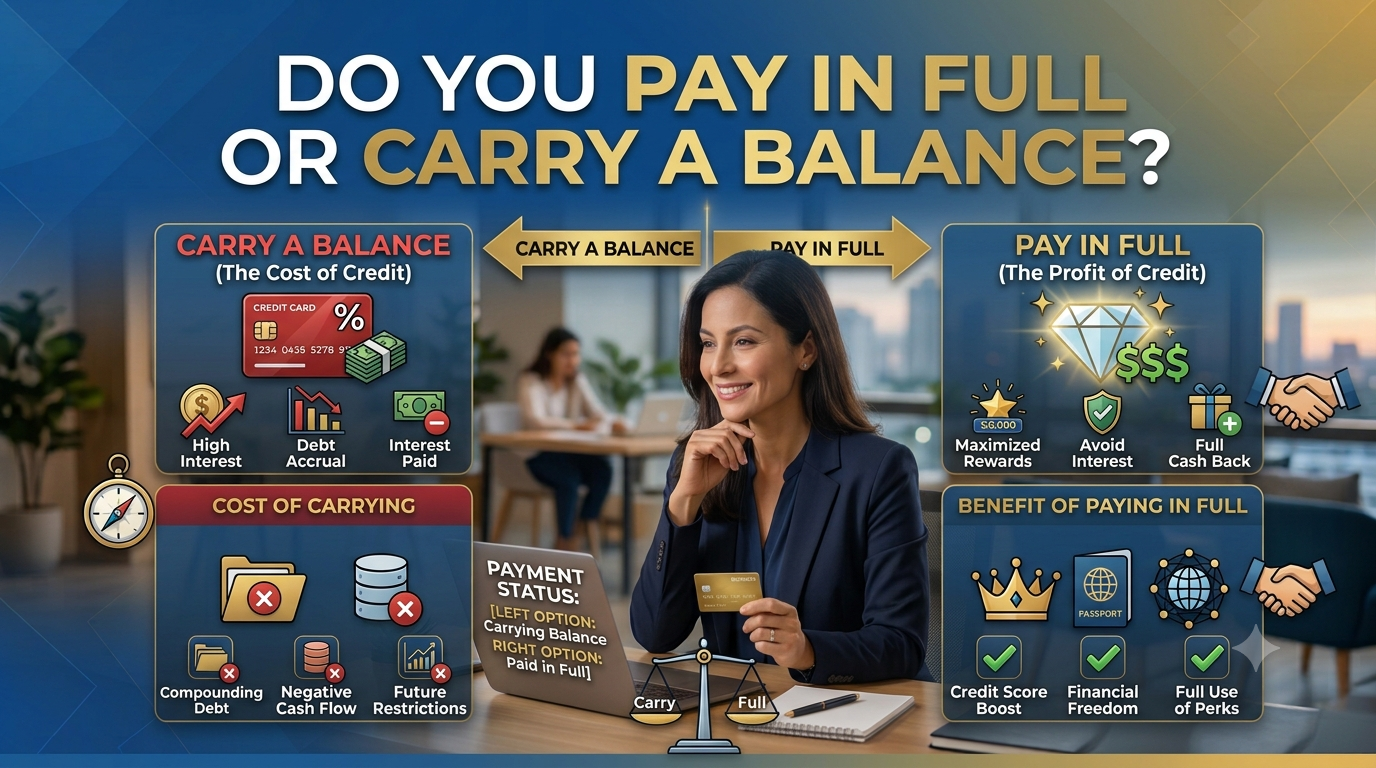
Here’s a quick illustration. Say your business earns 2% back on a $5,000 monthly spend. That’s $100 a month in rewards. Now say you carry a $5,000 balance for one month at a 24% APR. That costs about $100 in interest. One month of carrying a balance can wipe out an entire month of rewards. If that sounds familiar, favor a card with a lower APR or a long 0% introductory window.
Paying on time is the easiest way to avoid this trap. If a due date is close and you’re worried about a payment landing late, it helps to understand what an instant ACH transfer is and how it works, including what it costs and which alternatives exist.
2. What will the card really cost you?
The annual fee is only the visible part. Look at these as well:

- Foreign transaction fees. Many cards charge around 3% on purchases made abroad or with overseas vendors. Spending $20,000 a year internationally on a card with a 3% fee costs you $600.
- Late fees and penalty APRs. One missed payment can trigger both.
- Employee card fees. Some issuers charge extra for additional cards, while others include them for free.
- Cash advance fees. Rarely worth using, but good to know.
A card with a $95 fee can still be the cheaper option if it earns you several hundred dollars in rewards. A no-fee card isn’t automatically the better deal either. What matters is the net figure after everything is counted.
The same lesson applies far beyond cards: the headline rate is rarely the full price. Our breakdown of what it really costs to cash out crypto, including fees, spreads and taxes, shows how small charges stack up when you only look at the advertised number.
3. How do you want to be rewarded?
Business credit cards generally reward you in one of three ways:
- Flat cashback, typically around 1.5% to 2% on everything. Easy to understand and good for varied spending.
- Category bonuses, which pay higher rates on specific spending such as advertising, shipping, internet and phone service, or office supplies. These win when most of your spending lands in those categories.
- Points or miles, which can be worth more when redeemed for travel but take more effort to use well.
Match the structure to your spending. A design studio paying for software and ad platforms should look at category cards. A construction company buying fuel, tools and supplies may prefer a card with strong gas and supply rewards. A company with unpredictable expenses will probably be happiest with flat cashback.
Sign-up bonuses are nice but shouldn’t drive the decision. They require a minimum spend within a set time, and a card you’re stuck with for years matters more than a bonus you collect once.
4. Will you be personally liable?
Most traditional business cards require a personal guarantee. That means if the business can’t pay, you’re responsible for the debt. They also tend to check the owner’s personal credit, and approval depends heavily on your score.
Some corporate-style cards instead look at business revenue, bank balances and cash flow. These can suit newer companies or founders who want to keep personal and business credit separate. If that’s important to you, read the eligibility terms closely before applying.
Also find out which credit bureaus the issuer reports to. If it only reports to personal bureaus, your on-time payments won’t help build business credit.
5. What tools do your team and your accountant need?
If only you use the card, tools matter less. But once employees start spending, controls become valuable. Look for:
- Individual spending limits
- Restrictions by merchant or category
- Virtual card numbers for vendors and subscriptions
- Real-time alerts and receipt capture
- Integrations with QuickBooks, Xero or NetSuite
The more people spend, the more these features save you in admin time. Giving each recurring subscription its own virtual card, for example, makes it simple to see what you’re paying for and to cancel cleanly.
Eight business credit cards worth comparing
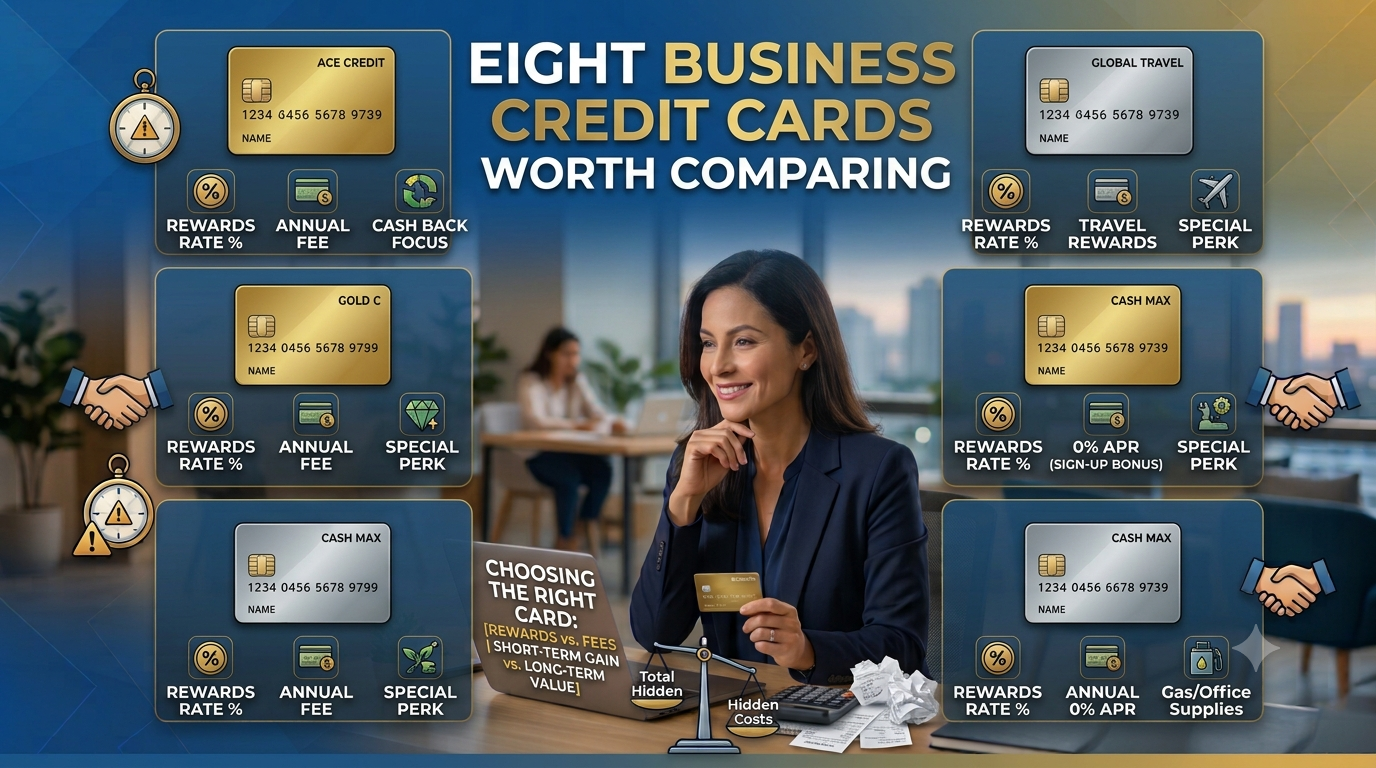
Figures below reflect the issuer terms listed as of October 2026. Always confirm current details before applying.
Capital One Spark 1.5% Cash Back: best for simplicity
With no annual fee, no foreign transaction fee and a single flat cashback rate, this is a good default for owners who don’t want to track categories. The variable APR runs from roughly 16.74% to 22.74%. It’s a strong pick for a business with mixed spending and some overseas purchases. The downside is that you won’t earn elevated rewards in categories where you spend heavily.
Chase Ink Business Cash: best for office and telecom spending
This no-annual-fee card pairs a 12-month intro APR offer with cashback built around common operating costs such as internet, phone and office supplies. It’s a good fit for small offices and home-based businesses. The 3% foreign transaction fee makes it a poor choice for international purchases.
Chase Ink Business Preferred: best for points on core business costs
At $95 a year, this card earns points rather than cashback and is designed for categories like travel, shipping, advertising and utilities. It has no foreign transaction fee, which helps businesses that pay overseas contractors or travel abroad. It makes the most sense if you’ll realistically earn back more than the fee in points.
American Express Blue Business Plus: best for 0% APR and flexibility
There’s no annual fee, and the card offers a 12-month introductory APR period. It’s popular with owners who want a simple rewards structure and room to grow their spending. Be aware of its 2.7% foreign transaction fee, and note that the standard APR range is wide, topping out at 28.49%.
U.S. Bank Business Triple Cash Rewards: best for long intro financing
This card has no annual fee and a 12-month introductory APR offer, then a variable rate in the high teens to mid-twenties. It’s a sensible pick if you plan a large near-term purchase, such as equipment or inventory, and want time to pay it off without interest. Make sure you can clear the balance before the promotional period ends. To plan a payoff schedule, plug the purchase amount and your timeline into the EMI Calculator and see what monthly payment clears it in time.
Bank of America Business Advantage Customized Cash Rewards: best for choosing your bonus category
With no annual fee, this card lets you select the category where you earn bonus cashback, so it can follow your spending as it changes. The introductory APR lasts 7 billing cycles, and foreign transactions carry a 3% fee. If you already bank with Bank of America, check whether you qualify for additional rewards boosts.
Capital One Venture X Business: best for premium travel
This is the high-end option, with a $395 annual fee, no foreign transaction fee, and a miles-based rewards program with travel perks. It works best for owners and teams who fly often and will use the benefits. If your travel is occasional, the fee will be hard to justify.
Marriott Bonvoy Business American Express: best for hotel stays
At $125 a year with no foreign transaction fee, this card is built for companies that book Marriott properties regularly. If your team splits nights between several hotel brands, a general travel card will likely serve you better.
A simple way to compare cards on real numbers
Reward rates look impressive in marketing, but only your own spending reveals a card’s true value. Here’s a quick method:
- Pull 12 months of business spending and group it into categories.
- Calculate rewards each card would have earned on that spending.
- Subtract the annual fee, any foreign transaction fees, and estimated interest.
- Count perks only if you’d use them and would otherwise pay for them.
A worked example: a company spends $60,000 a year. A flat 1.5% card with no fee earns $900. A category card with a $95 fee earns 3% on $20,000 of eligible spending ($600) and 1% on the other $40,000 ($400), for $1,000, minus the fee, leaving $905. The gap is tiny, so the simpler card is the better choice. If that same company spent $40,000 in the bonus category, the category card would pull well ahead. The answer depends entirely on where your money goes.
Before you apply: a practical checklist
Who can apply
You don’t need a big company or a staff. Sole proprietors, freelancers, consultants and side-business owners can often qualify, usually by applying under their own name and Social Security number. A registered entity such as an LLC or corporation will typically use an EIN.
What to have ready
- Legal business name and any trade name
- Address, phone number and industry
- Entity type and EIN (or SSN for sole proprietors)
- Time in business and annual revenue
- Expected monthly card spending
- Details of owners with significant stakes
- Bank statements, if the issuer reviews business finances
Keep your numbers realistic and consistent with your records, since issuers may ask for supporting documents.
Credit score expectations
Many traditional business credit cards look for a good-to-excellent personal score, often starting around 670. Cards that evaluate company finances instead can be easier to get if your personal credit is thin.
Protect your score while shopping
Each application can trigger a hard inquiry, and several in a short span can lower your score temporarily. Narrow your list to one or two cards first, and apply only when you’re confident.
Common mistakes to avoid
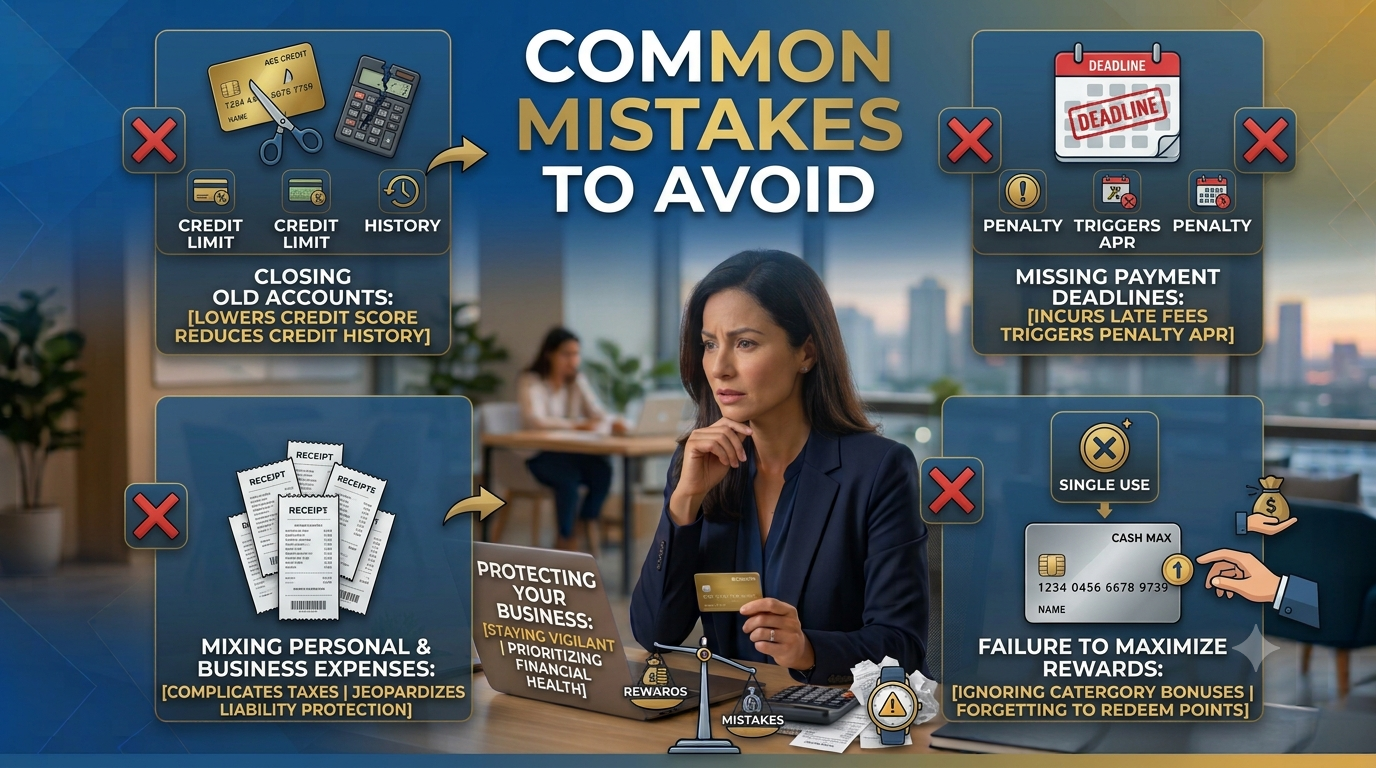
- Chasing the welcome bonus and ending up with a card that doesn’t fit daily spending
- Ignoring foreign fees when you pay international vendors
- Assuming the card builds business credit without confirming the issuer reports to commercial bureaus
- Handing out cards with no limits, which makes overspending and fraud harder to catch
- Missing the end of an intro APR and being hit with a high standard rate
- Mixing personal spending in, which undoes the main benefit of having a separate card
Frequently asked questions
Can a brand-new business get a business credit card? Yes. Many issuers approve new companies, but without a business credit history they usually rely on the owner’s personal credit and may ask for a personal guarantee.
Is it okay to have more than one business card? Yes, and plenty of companies do. Common reasons include separating departments, earning different reward types, or giving teams dedicated cards. Just make sure the extra complexity is worth it.
Can I use a business card for personal purchases? It’s best not to. It isn’t automatically illegal, but it complicates your books and taxes.
How many employee cards can I get? It depends on the issuer. Some include extras free, while others charge per card or cap the number.
Is a business credit card the same as a line of credit? No. A card suits day-to-day purchases and earns rewards, while a line of credit gives flexible access to cash for larger or ongoing needs.
Are credit card rewards taxable? Rewards earned from spending are generally treated as a discount on your purchases rather than income, but rules vary by situation. Check with a tax professional.
Do business cards help build business credit? Only if the issuer reports to commercial bureaus. Confirm this before applying.
The bottom line
The best business credit card is the one that costs you the least and rewards you the most for the way you actually spend. Start by working out whether you pay in full, where your money goes each month, and how much personal liability you’re comfortable with. Then compare two or three business credit cards using your own numbers, not the headline rewards rate.
If you do that, you’ll end up with a card that pays you back for spending you were already doing, rather than one that looks good in an ad.
Want more practical money guides and free calculators? Browse the full MoneySideOfLife blog for new articles every week.
