

What is an instant ACH transfer?
An instant ACH transfer is a bank-to-bank payment where the recipient sees the money within minutes, instead of waiting one to three business days.
The catch is that the ACH network can’t do this on its own. ACH collects payments into batches and settles them at set times on business days. So when someone offers “instant ACH,” the speed comes from something layered on top of the network.
Truly instant, seconds-fast transfers run on real-time rails like RTP or FedNow, not on the ACH network. Instant ACH is better described as an experience: the money shows up fast, and the slower ACH settlement happens behind the scenes.
In short: “instant ACH” usually means one of three things: a third-party provider that credits the money before the ACH settles, Same Day ACH (hours, not minutes), or a real-time rail like RTP or FedNow that people loosely group under the same label.
How instant ACH works
The most common model uses a third-party provider, such as a payments platform or accounts payable software. The receiver is paid right away, while the ACH transfer to the provider completes on the usual timeline.
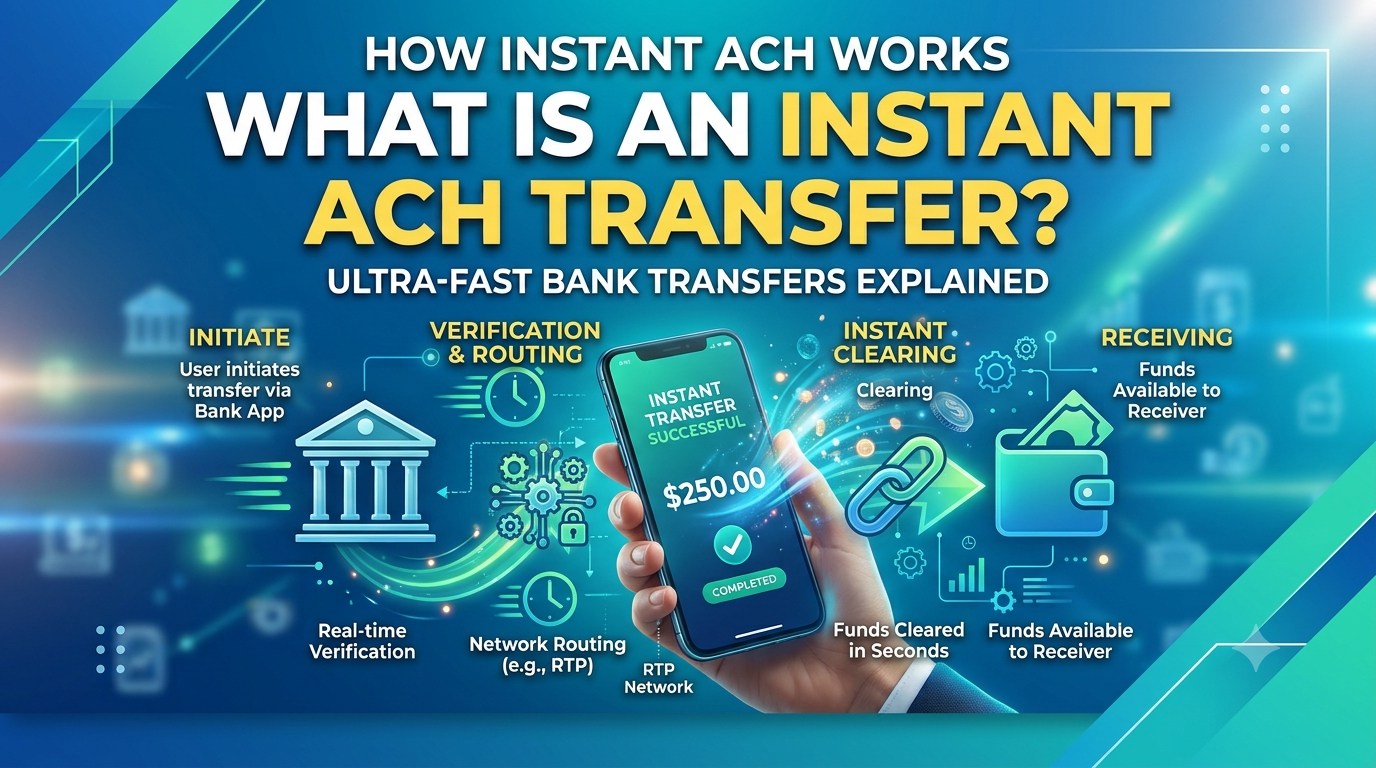
- You initiate the payment in the provider’s app or software.
- The provider checks the transaction. This often includes verifying the account and assessing risk in real time, because the provider is about to advance its own money.
- The provider credits the recipient, often within minutes, using its own funds or a faster rail.
- The provider collects from you through a standard ACH debit over the following days.
That ordering explains the rules that follow. The provider takes the risk (your account might be empty, or the debit might be returned), so it charges a fee and may limit amounts or eligibility.
Standard ACH vs. Same Day ACH
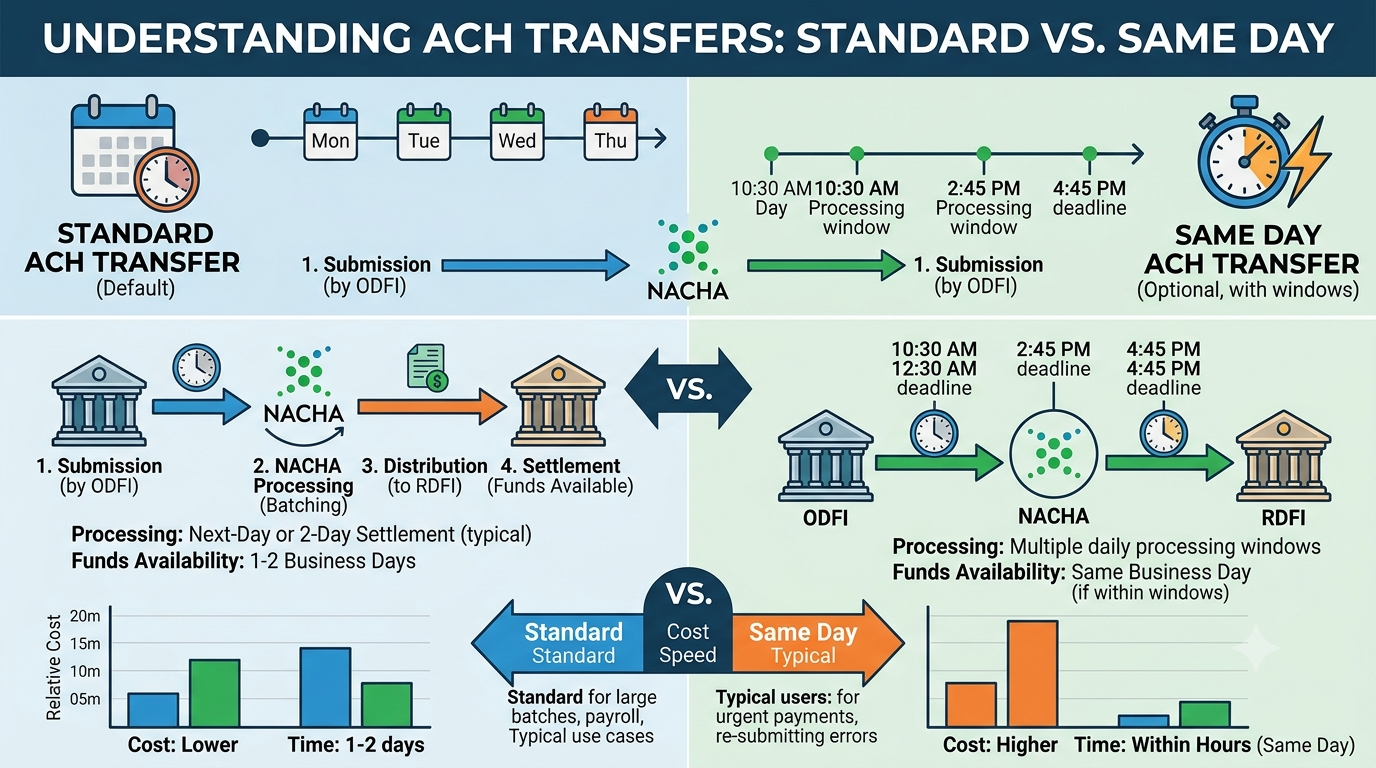
Standard ACH settles in batches on business days. Transfers usually take one to three business days, and weekends and bank holidays don’t count.
Same Day ACH is the network’s own faster option, governed by Nacha rules. It isn’t handled “per request.” It runs through three fixed daily windows. Banks can submit files at 10:30 a.m., 2:45 p.m. and 4:45 p.m. ET, with settlement at 1:00 p.m., 5:00 p.m. and 6:00 p.m. ET.
Key rules:
- Limit: Same Day ACH is capped at $1 million per payment. Anything higher isn’t rejected; it moves to next-day settlement.
- Upcoming change: Nacha will raise the limit to $10 million effective September 17, 2027.
- Funds availability: Receiving banks must make consumer credits available by 1:30 p.m. local time for the first window, 5:00 p.m. for the second, and by the end of the processing day for the third.
- Exclusions: International (IAT) entries aren’t eligible.
- Bank limits: Banks can set lower limits for their own customers, so your cap may be well under $1 million.
- Volume: Nacha reported 403 million Same Day ACH payments worth $1.1 trillion in Q1 2026, up 23.6% year over year.
Same Day ACH is fast and low cost, but it still depends on business days and cutoffs. A payment sent on Saturday won’t move until the next processing day.
Instant ACH vs. RTP vs. FedNow vs. wire
| Standard ACH | Same Day ACH | Instant ACH (third party) | RTP / FedNow | Wire | |
|---|---|---|---|---|---|
| Speed | 1–3 business days | Hours, by window | Minutes | Seconds | Minutes to hours |
| Runs on | ACH | ACH | Provider on top of ACH | Own 24/7 networks | Wire network |
| Availability | Business days | Business days | Depends on provider | 24/7/365 | Business hours, generally |
| Network limit | Varies | $1M ($10M from Sept 2027) | Set by provider | $10M | Typically bank-set |
| Reversible? | Yes, via returns | Yes, via returns | Provider’s debit can still be returned | Generally final | Very hard |
| Cost | Lowest | Low | Provider fee | Often modest | Highest |
About the real-time rails: RTP’s network limit is $10 million, raised from $1 million in February 2025, and FedNow’s also reached $10 million in November 2025. Both are credit-push, 24/7 networks. In Q2 2026, RTP processed about 142 million transactions versus nearly 5 million for FedNow. Banks can still impose lower limits, so check yours.
How much does instant ACH cost?
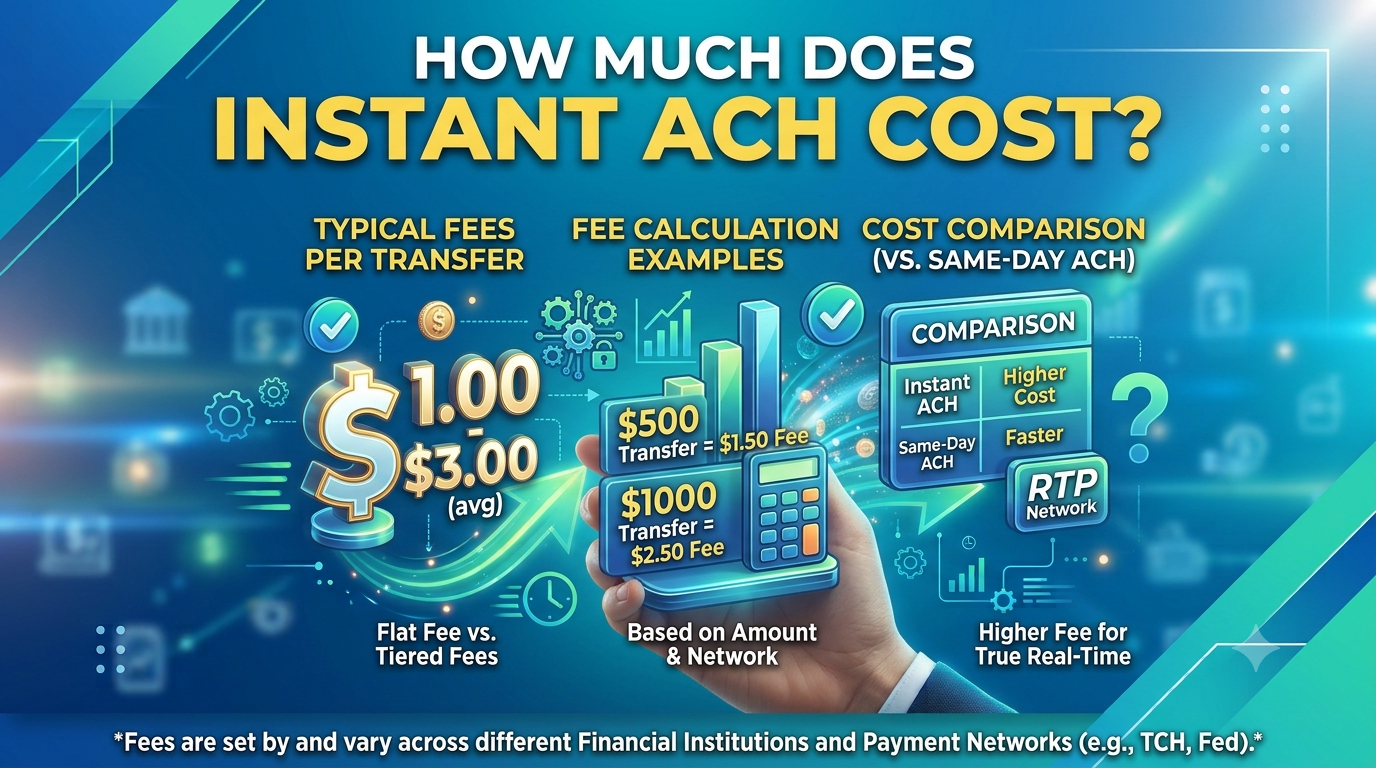
There’s no single price. Providers typically use a flat fee, a percentage of the amount, or both. One analysis puts typical ranges at $1–$5 per transaction or 0.5%–1.5% of the amount. Treat these as ballpark figures, since pricing varies by provider and plan. For comparison, bank wires are often priced far higher, and standard ACH is often free or only a few cents to a few dollars.
Many consumer apps charge a similar “express” fee to speed up deposits. Our guide to the best money borrowing apps in 2026 shows how those instant-transfer fees can make a small advance surprisingly expensive.
Pros and cons of instant ACH
Benefits
- Fast access to funds for urgent vendor, payroll or contractor payments
- Lower cost than a wire for many use cases
- Helps with cash flow and with capturing early-payment discounts
- No need to change how the receiver’s bank works
Drawbacks
- Not available at every bank. Many institutions still rely on standard or Same Day ACH.
- Fees apply, and they’re higher than standard ACH
- Errors in payment details or insufficient funds can delay the transfer or cause it to fail
- Limits may be lower than those on real-time rails
- Speed leaves less time to catch fraud (see below)
Small per-transfer fees are easy to overlook, but they add up. If you pay for speed often, our walkthrough on identifying hidden monthly expenses that quietly reduce your savings can help you spot the habit.
Risks and fraud to know about
Speed shortens the window to catch mistakes. Before sending:
- Verify the recipient’s bank details through a second channel. Be wary of emails asking you to “update payment information,” a common business email compromise tactic.
- Check that the funding account has enough balance. A failed debit behind a fast credit can create problems for you or your provider.
- Understand the return rules. ACH payments can be returned, while real-time rail payments are generally final once sent.
Nacha’s updated fraud-monitoring rules also require certain originators and banks to run risk-based fraud detection. Phase 1 took effect in March 2026 for high-volume parties, and Phase 2 extends to smaller originators by June 2026. If you originate ACH payments, confirm with your bank or processor what applies to you.
Which option should you use?
- Need it in seconds, any time, with finality: RTP or FedNow, if both banks participate.
- Need it today, during business hours, at low cost: Same Day ACH, submitted before the cutoff.
- Need it in minutes but your bank doesn’t support real-time rails: a third-party instant transfer provider.
- Moving very large amounts with legal certainty: a wire.
- No urgency: standard ACH, which is cheapest. If cash is tight and you’re tempted to pay for speed, compare a cash advance app with other options first.
Is it worth paying for speed?
Paying for fast transfers makes sense for genuinely urgent payments. If you’re regularly paying fees to move money sooner, check your cash flow first. When a loan payment is the pressure point, our free EMI Calculator shows what your monthly installment really costs, and our guide on how extra principal payments change your payoff date shows how to cut the total.
Frequently asked questions
Is there such a thing as a truly instant ACH transfer? Not on the ACH network itself. What users get is a fast credit from a provider, or a switch to a real-time rail.
Is Same Day ACH the same as instant ACH? No. Same Day ACH runs in three fixed windows on business days, so it takes hours. It’s faster than standard ACH but not instant.
Are Zelle and Venmo instant ACH? They are consumer payment apps that credit funds quickly. They are separate services, not the ACH network sped up, so don’t treat “Zelle = ACH” as a rule.
How long do instant ACH transfers take? Usually minutes, depending on the provider and the receiving bank. Errors or insufficient funds can add delays.
Is instant ACH reversible? The underlying debit from the sender’s account follows ACH return rules. Check the provider’s terms for what happens once the recipient has been credited.
What’s the maximum amount? It depends on the provider and your bank. Network limits are $1 million for Same Day ACH and $10 million for RTP and FedNow, but your bank may set lower caps.
