


Extra mortgage payments are one of the few money moves where a small, steady habit can erase years of debt and tens of thousands of dollars in interest. Most homeowners simply pay the amount printed on their statement for 30 years and never question it. But that number is a minimum, not a ceiling. In this guide, we will show you how paying more works, run real numbers on a $300,000 loan, compare five practical ways to do it, and help you decide whether it fits your finances right now.
How Extra Mortgage Payments Work
To understand why paying more is so powerful, you first need to understand amortization. Your lender calculates interest every month on the balance you still owe. At the start of a loan, that balance is at its highest, so most of your payment goes to interest rather than to the money you actually borrowed.

Here is what that looks like. On a $300,000, 30-year fixed loan at 6.5%, your principal-and-interest payment is about $1,896. In the very first month, roughly $1,625 of that goes to interest and only about $271 reduces your balance.
Now imagine you send an additional $271 toward principal in month one. That money does not just shave $271 off your debt. It also removes every dollar of future interest that would have been charged on that $271 for the next 30 years. Because the balance is smaller, next month’s interest is smaller too, so a little more of your regular payment goes to principal automatically. It is compounding working in your favor instead of against you.
There is one condition. The additional money must be applied to principal. If your servicer treats it as an early payment of next month’s bill, you get almost none of the benefit. More on that below.
Real Numbers: What Paying Extra Saves on a $300,000 Loan
Here are five scenarios on the same loan: $300,000, 30-year fixed, 6.5% interest, with the added money applied to principal from the first month.
| Strategy | Payoff time | Total interest paid | Interest saved | Time saved |
|---|---|---|---|---|
| Regular payments only | 30 years | $382,633 | — | — |
| $100 extra per month | 26 years | $321,639 | $60,995 | 4 years |
| One added payment per year ($1,896) | 24 years, 4 months | $298,649 | $83,985 | 5 years, 8 months |
| $200 extra per month | 23 years, 1 month | $279,185 | $103,449 | 6 years, 11 months |
| $500 extra per month | 17 years, 6 months | $202,874 | $179,759 | 12 years, 6 months |
These figures are illustrations, not predictions. Your rate, balance, and timing will change the results. A lower rate means smaller savings, and a higher rate means larger ones. But the pattern holds for nearly every borrower: the earlier in the loan you start, and the more consistently you do it, the bigger the payoff.
Notice what the middle row shows. Adding just one full payment per year, which works out to about $158 a month, cuts nearly six years off the loan and saves roughly $84,000 in interest. That is the reason this strategy is so popular. It feels manageable, yet the long-term effect is large. You can test your own numbers with an EMI calculator that shows a full amortization breakdown before you commit.
Five Ways to Pay Extra on Your Mortgage
There is no single right method. The best approach is the one you will actually stick with. Whichever you choose, extra mortgage payments only work when your servicer applies them correctly, so confirm that first.
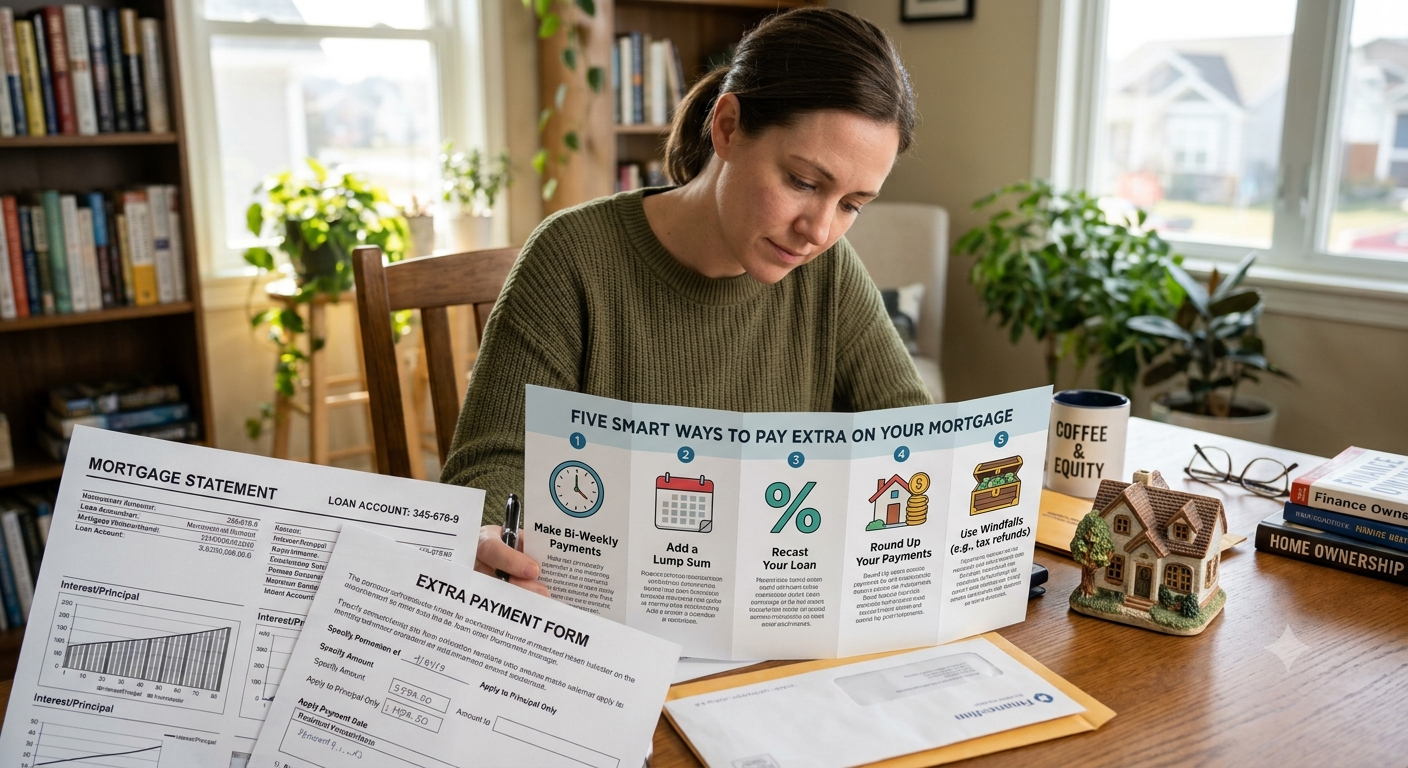
1. Add a little to every monthly payment
This is the easiest habit to automate. Pick an amount, whether $50, $100, or one-twelfth of your regular payment, and set up a recurring transfer. Because it is small and predictable, it is easy to budget around.
2. Make one lump-sum payment each year
If your income is uneven, or you receive a bonus, commission, or tax refund, a yearly lump sum may suit you better. Some homeowners earmark the money the day it arrives so it does not get absorbed into everyday spending. Paying earlier in the year saves slightly more interest than paying at the end, but the most important thing is that it happens at all.
3. Switch to biweekly payments
Paying half your monthly amount every two weeks gives you 26 half-payments a year, which equals 13 full payments. That is the same as making one added payment annually. Check how your servicer handles this first. Some hold each half-payment until the full amount arrives, and some charge a setup fee. If that is the case, you can get the same result by dividing your monthly payment by 12 and adding that amount each month, with no third party involved.
4. Round up your payment
If your payment is $1,896, send $2,000. Rounding up to a clean number is painless, and the extra goes straight to your balance. Over time, you will barely notice it, but your lender will.
5. Use a lump sum, then recast
If you receive a large windfall, such as an inheritance or the proceeds from selling another property, you can pay down a big chunk of principal and ask your lender to recast the loan. Recasting re-calculates your monthly payment based on the new, lower balance while keeping the original term. Your monthly bill drops, which gives you breathing room, though you will not shorten the loan unless you keep paying the old amount. Recasting usually involves a modest fee, and it is generally not available on government-backed loans such as FHA or VA, so ask your servicer.
Before You Send Any Money: A Quick Checklist
A few minutes of preparation prevent most of the problems people run into.
- Check for prepayment penalties. Most modern home loans do not charge them, but read your loan documents or call your servicer to be sure.
- Designate the money as principal-only. Use the servicer’s online portal, which usually has a separate field for additional principal, or write it clearly on a check. Do not assume it will be handled correctly by default.
- Verify the result. Look at your next statement and confirm that the principal balance dropped by the amount you sent.
- Keep your regular payment on time. Extra money does not excuse a missed due date.
Are Extra Mortgage Payments Worth It?
For many people, yes, but not for everyone and not always first. Paying down your mortgage gives you a guaranteed, risk-free return equal to your interest rate. If your rate is 6.5%, every dollar you prepay effectively earns 6.5% by eliminating interest you would otherwise pay. That is a strong return for something with no market risk.
However, the right answer depends on what else your money could be doing. Consider paying extra when:
- You have no high-interest debt such as credit cards or personal loans
- You hold an emergency fund covering several months of expenses
- You are already capturing any employer retirement match
- Your mortgage rate is relatively high compared with the interest you would earn on savings
- You want to reach 20% equity sooner and drop private mortgage insurance
On the other hand, consider waiting if:
- You are carrying debt with a higher rate than your mortgage, since paying that off first almost always saves more
- You have little or no cash cushion, because money placed in your home is hard to get back out quickly
- You are leaving a retirement match unclaimed
- Your mortgage rate is very low and you would comfortably earn more elsewhere
If you are weighing prepaying against investing, this plain-language investment guide for beginners is a useful starting point. A balanced approach is perfectly reasonable. You might split a bonus, putting half toward your mortgage and half toward savings or investments. A smaller consistent amount beats a large amount you cannot sustain.
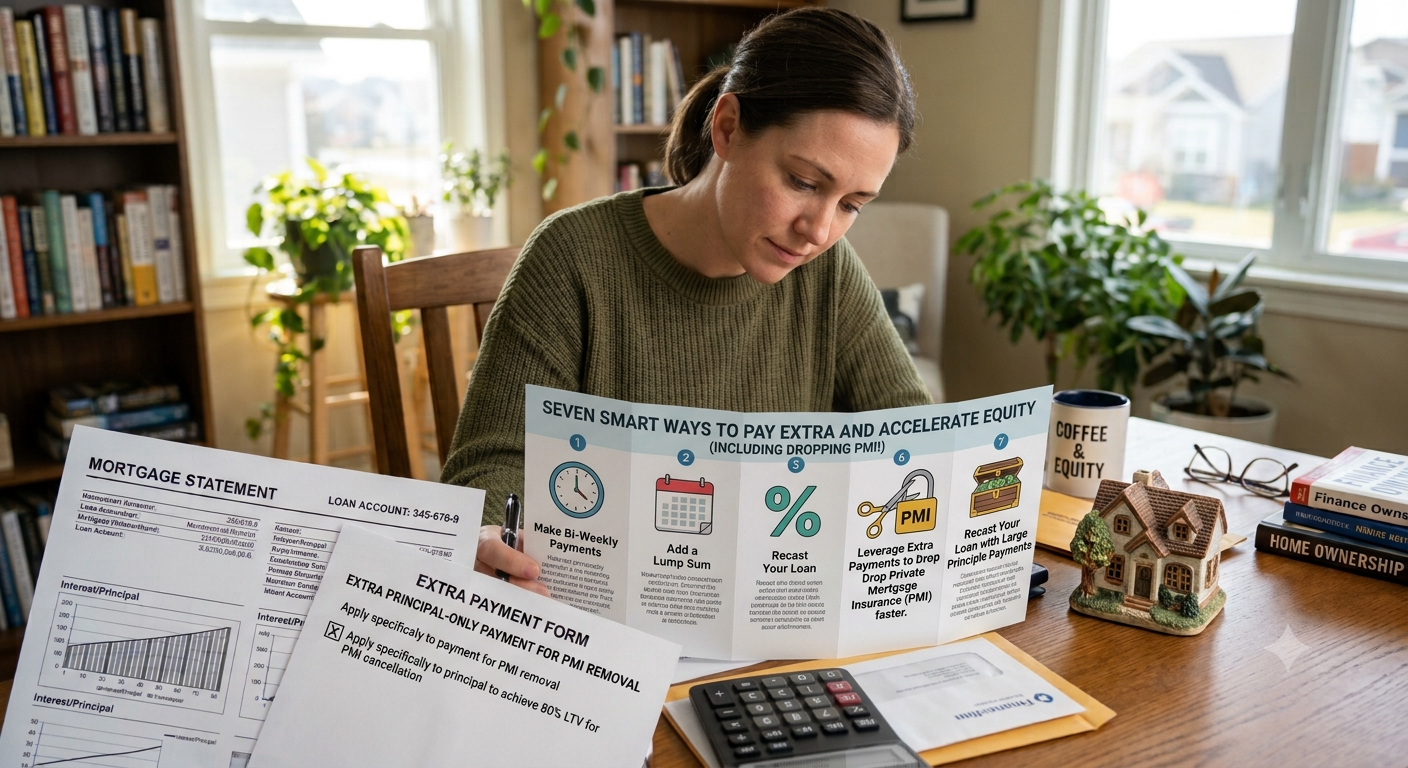
Paying Extra Can Also Help You Drop PMI
If you put down less than 20%, you are probably paying private mortgage insurance. On most conventional loans, you can ask your servicer to cancel PMI once your balance reaches 80% of the home’s original value, and it generally ends automatically at 78%. Paying extra principal gets you to that threshold sooner, which can lower your monthly cost as a bonus on top of the interest savings. Rules differ for FHA loans, where mortgage insurance often lasts much longer, so check the terms of your specific loan.
Common Mistakes to Avoid
- Draining your emergency fund. Home equity is illiquid. You cannot spend it at the grocery store, and borrowing against it takes time and money.
- Letting the extra go to the wrong place. If it is not applied to principal, it may just prepay next month’s bill.
- Starting big and quitting. A modest amount you keep up for 25 years beats a heroic amount you abandon after six months.
- Ignoring better uses. High-rate debt, a retirement match, and a basic safety net usually come first.
- Forgetting to revisit the plan. Raise your amount when your income rises, and pause it if your situation changes.
Frequently Asked Questions
Will paying extra lower my monthly payment?
No. Your required payment stays the same unless you recast the loan. What changes is how quickly your balance falls, which shortens the loan and cuts total interest.
Is it better to pay extra every month or once a year?
Earlier is generally better, because interest is calculated on the balance you owe and a lower balance sooner means less interest. In practice, the best option is whichever one you can maintain. A monthly add-on and a once-a-year lump sum of the same total produce similar results.
Can I pay extra on any mortgage?
Most mortgages allow it, but terms vary. Review your loan documents for prepayment penalties and ask your servicer how to designate additional principal.
The Bottom Line
Extra mortgage payments turn the most predictable expense in your budget into a lever you control. Even a modest add-on, like $100 a month or one additional payment a year, can shorten a 30-year loan by years and save tens of thousands of dollars in interest. Start by confirming there is no prepayment penalty, make sure your money is applied to principal, and be sure your emergency fund and higher-rate debts are handled first. Then pick a method you can stick with and let time do the heavy lifting. For more practical money guides, browse the MoneySideOfLife blog.
This article is for general educational purposes and is not financial advice. Calculations are illustrative and assume a fixed rate with no changes to escrow, taxes, or insurance. Consider speaking with a licensed mortgage professional or financial advisor about your situation.
